
260 modelling balloons are the long, thin balloons used for twisting — but in organic decor they do a different job. Inflated to 20–30cm and tucked into a garland, a 260 reads as a curl or a tendril: it breaks up the round shapes, adds movement, and gives a garland the "grown" look that separates a stylist's work from a party-shop kit. Two or three per metre in the garland's own colours is usually enough. Here's how to use them, how to inflate them, and why the colour match matters more than people think.
What is a 260 balloon?
The name is the size: 2 inches wide and 60 inches long at full inflation (about 5cm × 150cm). It's the standard twisting balloon for balloon animals, arches and columns. Stylex 260s come in 17 colours chosen to match the round range, in bags of 100. They are air-fill only — the volume is too small for helium to lift.
How do you use 260s in an organic garland?
Three ways, in order of how often I use them:
- Curls. Inflate the 260 to about 25cm, tie it, then wrap it around a finger or a marker and hold for a few seconds — it keeps a loose spiral. Tuck the knot end into the garland so the curl springs out between the 12s. Two or three per metre, same colour as the balloons around them.
- Tendrils. Inflate to 30–40cm, tie, and let it hang straight down from the underside of a garland or arch. Works on mounted installs where the garland is above eye level.
- Accents. A single contrasting 260 — Chrome Gold through a White Sand garland, say — draws the eye to one spot. Use sparingly; one per metre at most.
Attach with glue dots or low-temp glue at the knot, or thread the knot into the garland tape between two clusters.
How do you inflate a 260?
Not by mouth. A dual-action hand pump with a narrow nozzle does it; most electric inflators have a 260 tip. Leave 5–10cm uninflated at the tail — a fully inflated 260 has nowhere to go when you twist or curl it and will pop. Tie the neck with a simple overhand knot after stretching it once.
Do 260s match the round balloons?
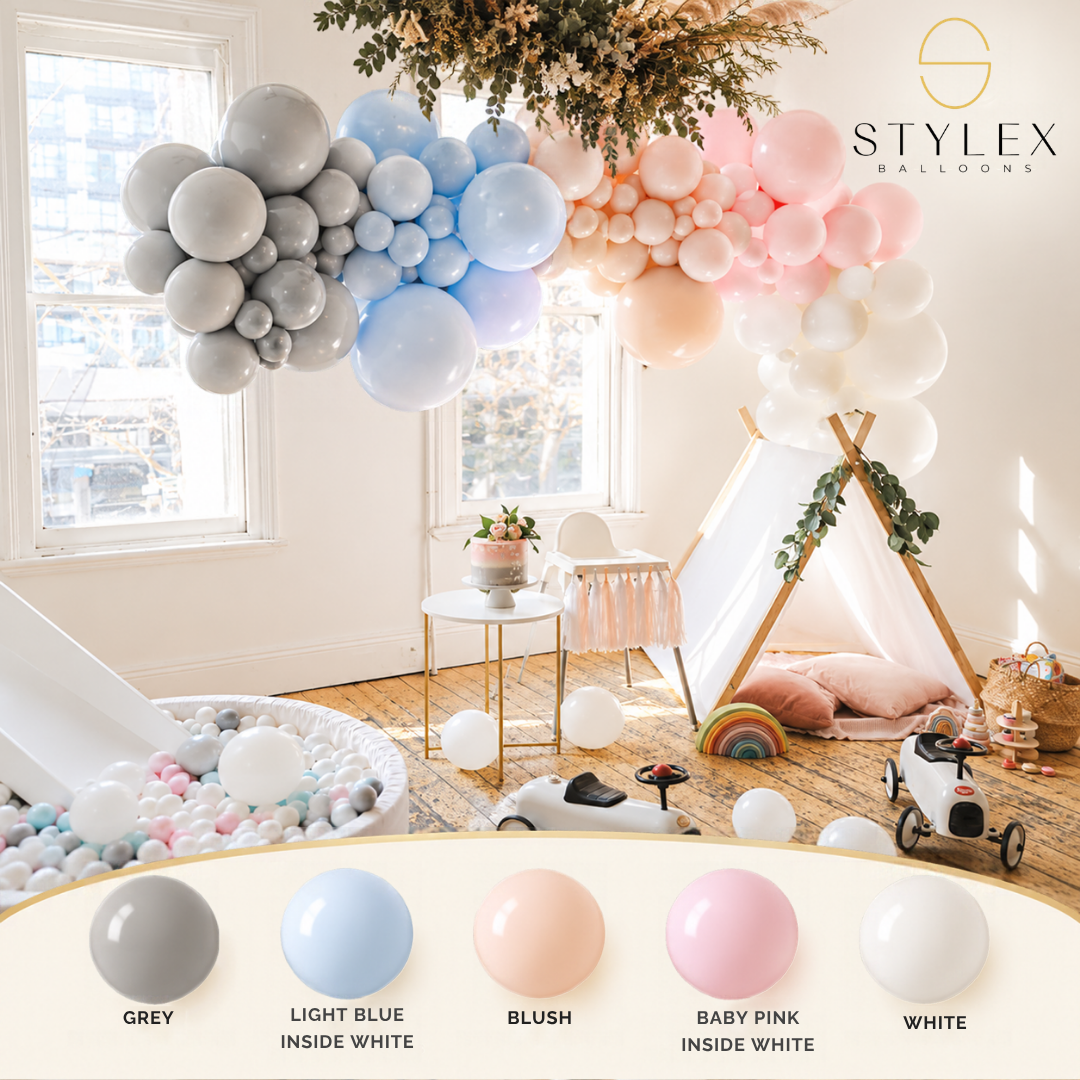
Ours do — same pigments, same supplier, so a White 260 is the same white as a White 12", and a Hunter Green 260 matches Hunter Green in every size. That matters more than it sounds. A garland is read as one object, and a 260 that's a near-miss on colour is the first thing a client notices. The Colour Chart shows rounds and 260s side by side.
Which 260 colours do stylists order most?
From our orders: Clear and White first by a wide margin — Clear is the "invisible" curl that adds texture without colour, White goes into almost every palette — then Black, Baby Pink, Light Blue and Blush. For the full list, see the 260 collection; for how they fit into a palette, the colour palettes guide.
How many 260s do I need?
| Use | Per metre of garland | 3m garland | 5m arch |
|---|---|---|---|
| Curls (standard) | 2–3 | 8 | 12–15 |
| Curls (dense, textured look) | 4–6 | 15 | 25–30 |
| Tendrils on a high install | 1–2 | 5 | 8 |
| Contrast accents | 0–1 | 2–3 | 4–5 |
A bag of 100 covers a lot of jobs; most stylists hold White, Clear and their two main palette colours.
Quick answers
Can you put helium in a 260?
No — it won't lift. Air only.
What's the difference between 260 and 160 balloons?
160s are 1" wide and 60" long — thinner, for fine detail twisting. 260s are the standard; they're what we stock.
How long do 260s last in a garland?
Air-filled and indoors, as long as the garland — days to a week-plus. They lose a little tension over time, which actually softens the curl nicely.
Counts for the rest of the garland: counts per metre. Build order: how to build an organic balloon garland.
Evra is a Sydney balloon stylist and the founder of Stylex Balloons, a wholesale latex balloon range made for organic decor.